

German Development Cooperation provides answers
 Berlin, April 2006 - (by InWEnt/gtz/DED) Among all continents, Africa has the highest percentage of people living in absolute poverty and infected with HIV. Education and knowledge play a crucial role for its economic and social development.
In September 2000, the UN member states pledged to reduce world poverty, secure peace, protect the environment, and make globalisation equitable and sustainable. Germany's strategy for meeting these commitments is embodied in the Programme of Action 2015. This programme, which involves several ministries, is the German contribution to achieving the goals of the international community.
The Programme of Action 2015, under the leadership of the German Federal Ministry for Economic Cooperation and Development (BMZ), is a call to action for society as a whole. It aims at promoting development in line with the principles of sustainability. Promoting education is a key priority in this.
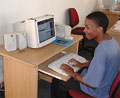
Education - basic education, training, and upgrading - is essential to enable the poor to take part in economic and social life. Information and communication technologies can support this process. On the one hand, the use of information and communication technologies enables broad sections of the population to exchange information quickly and on the other, it affords new earning and job opportunities.
Besides creating the necessary infrastructure capacities, the aim of the German Development Cooperation is to provide appropriate training and upgrading opportunities for handling ICT. eLearning, plays a very special role in technology-assisted learning and teaching. To be successful, eLearning courses in the different regions must be designed to meet diverse needs and preconditions.
The advantages afforded by using modern learning technologies in training and upgrading are learning independently of time and place, the rapid provision of localised, updated course content, and the timely conduct of courses with participants from different regions. The use of new media, though, is not the only key to a successful educational outcome; a quality technology-assisted education project can only work when the organisational structure, pedagogy, methodology, and content are professionally adapted and implemented.
At eLearning Africa 2006, German Development Cooperation will present its joint efforts at promoting the use of eLearning for sustainable development. Together with partners from Africa, staff from Capacity Building International, Germany (InWEnt), the German Development Service (DED), and the Deutsche Gesellschaft für Technische Zusammenarbeit (GTZ) GmbH will report on their experience.
Under the heading Capacity Building in and for eLearning, we present the schemes for the ICT-assisted training of knowledge multipliers in eLearning. The joint Special Focus Session entitled -œHealth Knowledge through eLearning- provides an outline of ways to impart health-related information with the help of eLearning.
At their exhibition stand, BMZ, DED, GTZ and InWEnt will also present current developments, strategies, and approaches for establishing eLearning capacities in cooperation with partner countries of German Development Cooperation.
The Federal Ministry for Economic Cooperation and Development (BMZ) defines the guidelines and strategies for German development policy. It sets out the long-term strategies for cooperation with the various actors and defines rules for their implementation. Joint projects are subsequently developed with partner countries on this basis. The BMZ is the main client of the German organizations InWEnt, DED, and GTZ.
InWEnt - Capacity Building International, Germany - is committed to human resource and organizational development in international cooperation. Global Campus 21â is a knowledge portal for international further education and cooperation. Here, experts and management staff from all over the world have an opportunity to continue their education beyond national frontiers.
The Deutsche Gesellschaft für Technische Zusammenarbeit GmbH (GTZ) is a government enterprise with worldwide operations in international cooperation for sustainable development, implementing bilateral and multilateral projects in more than 130 countries. The transnational project Crystal - ICT-based Professional qualification, offers comprehensive consultancy on developing eLearning schemes in partner countries of German Development Cooperation.
The German Development Service (DED) is one of the leading European personnel-secondment services. It is active in programmes and projects in over forty countries worldwide that contribute to improving the conditions of life for the population. ELearning plays a particularly important role in DED's vocational education programme in southern and eastern Africa.